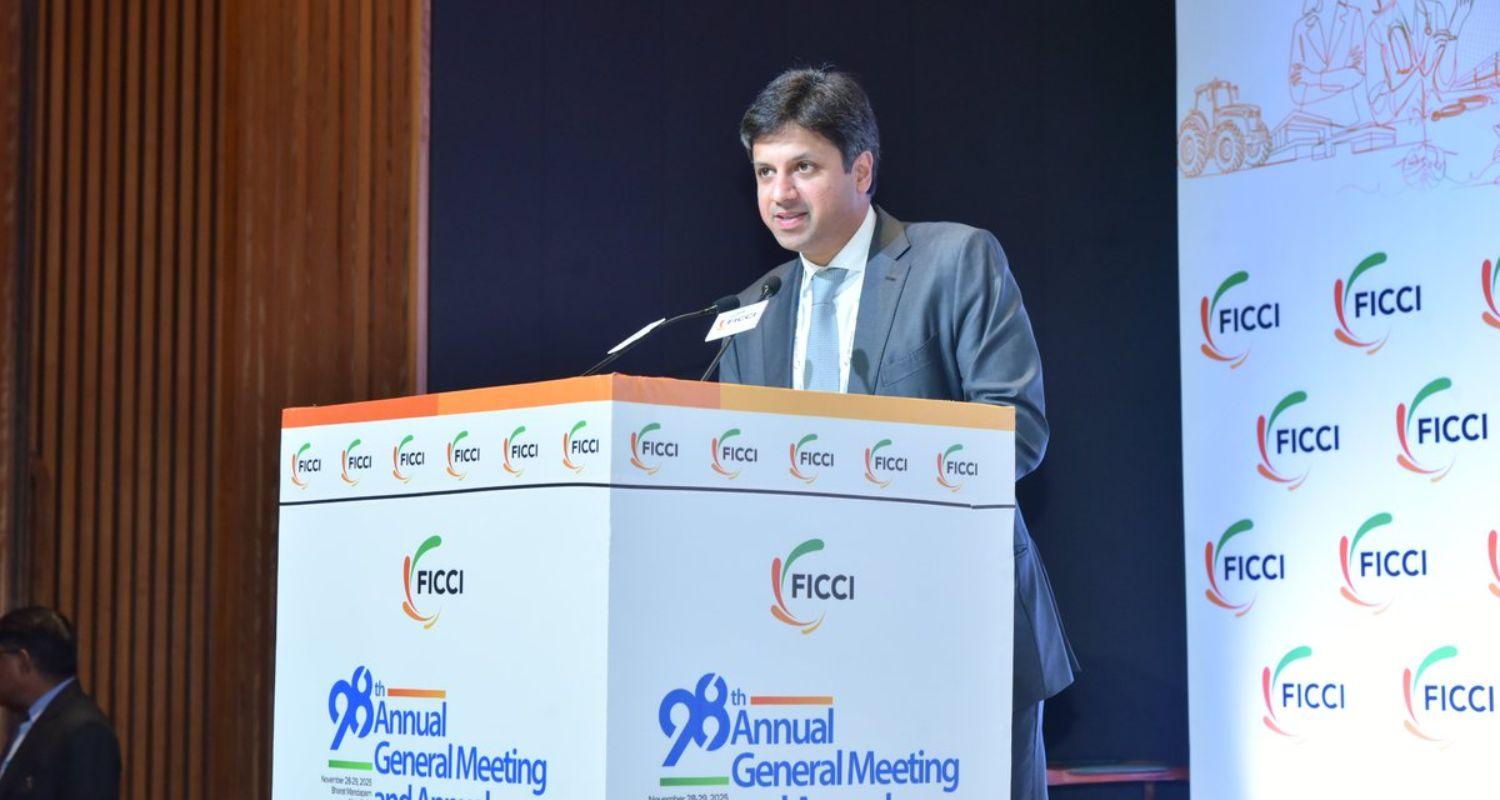
India will continue to witness sustained growth of over 7 per cent in this fiscal year, as government reforms and strong macro fundamentals support domestic output, said Anant Goenka, President of Federation of Indian Chambers of Commerce & Industry (FICCI), at an event on Tuesday.
“I think GDP should be 7 plus kind of level (during 2025-26). After all the changes that have happened with respect to the income tax slab, GST changes, and labour code changes, I think that with the reforms coming in, the macros of India are looking very strong,” he said.
The “sweet spot” of growth that Goenka referred to is the “Goldilocks economy” that many are calling it, after India reported an 8.2 per cent GDP growth in the second quarter of this financial year.
The chamber’s focus, said the newly-elected president, would be to increase the share of the manufacturing sector in the GDP from its current 15-17 per cent to 20-25 per cent level, for which it has outlined priorities such as increasing R&D spending from 0.7 per cent to over one per cent of GDP; strengthening industry-academia partnerships, supporting the government’s efforts to further promote ease-of-doing-business, trade and supply chain security, and enhancing manufacturing excellence which includes focus on quality, women in the workforce, and adopting sustainable practices.
Also Read: Manufacturing sector poised for strong growth, finds FICCI survey
Goenka, who is also Vice-Chairman of RPG group, said the chamber will also work with states on further improving the business climate of the country.
While suggesting further simplification of rules and promotion of trust-based governance, he promised to address challenges at the trade front in a “very” short period of time, adding, “so to that extent, we’re in a sweet spot. Private investment capex is also something which is ready for a change.”
As capacity utilisation rises, greenfield investments by industry will also pick up, he added.
On reviving private investments in the country, he said they were faced with issues like insolvency problems, drying up of demand due to the pandemic and global trade uncertainty.
“We are coming to an end of some of these challenges, and we’re seeing all the macros are fairly positive,” he said, hailing GST rate cut reforms of the government.
“Initially, rural demand was weak because of inflationary impact post-COVID, and more recently, it’s been semi-urban, urban. There’s been a slight slowdown, but now the data is showing a positive shift,” he said.
India’s economy grew at a higher-than-expected 8.2 per cent – the fastest pace in six quarters – in July-September, as front-loading of production ahead of GST rates cut boosted consumption that helped offset the impact of steep US tariffs.
The 8.2 per cent gross domestic product (GDP) growth, which follows a 7.8 per cent expansion in the preceding April-June quarter, helped India retain the title of the world’s fastest growing major economy, according to official data released on Friday.
The expansion, which was more than China’s 4.8 per cent, was driven by higher public investments, services demand, industrial output and firm consumption, besides statistical effects of a low base (the economy grew at a below-average 5.6 per cent in the same quarter last fiscal).

 Follow us