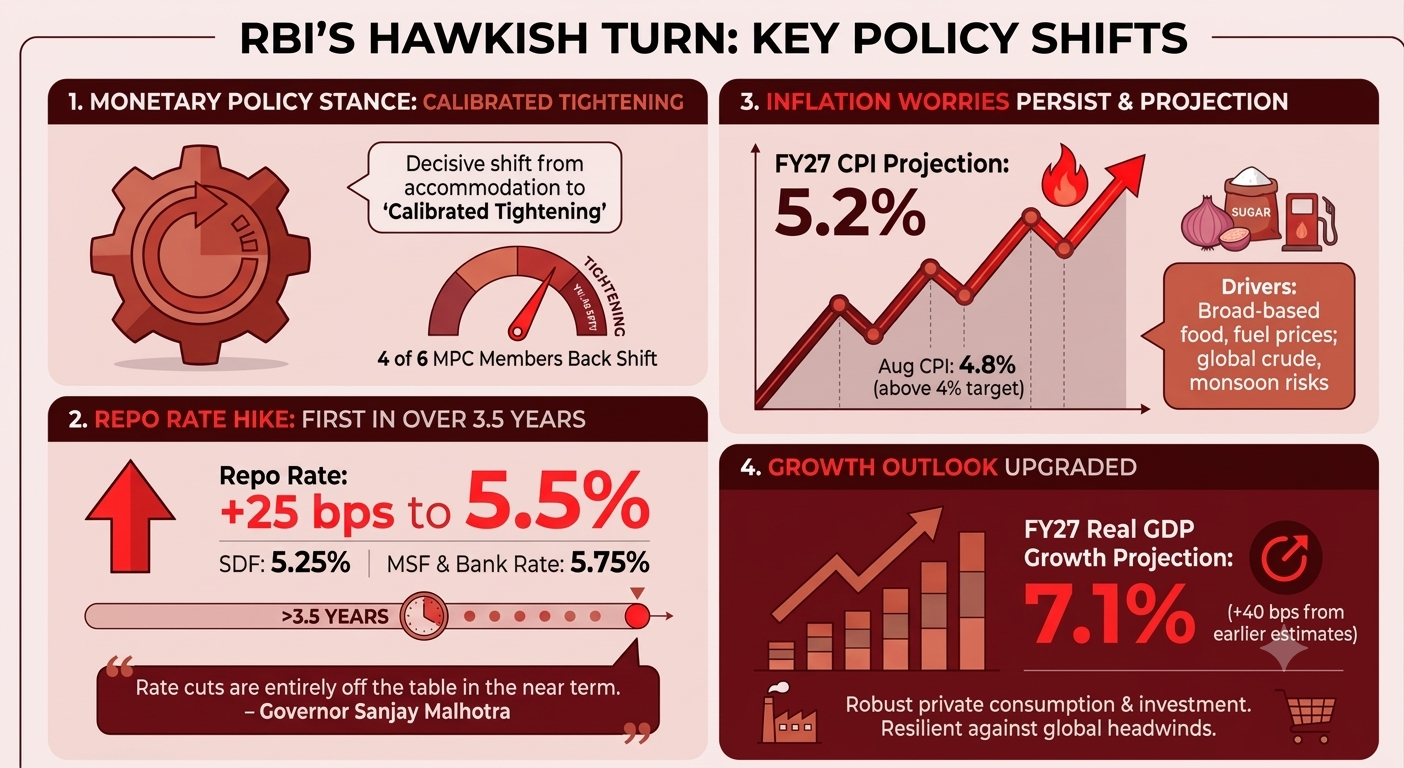
The Reserve Bank of India (RBI) has raised its benchmark lending rates by 25 basis points, ending nearly two years of monetary accommodation and marking the first rate increase in more than three-and-a-half years. The decision was unanimously approved by all members of the Monetary Policy Committee (MPC).
Following the revision, the repo rate now stands at 5.5%, while the standing deposit facility rate has been raised to 5.25%. The marginal standing facility rate and the Bank Rate have both been revised to 5.75%.
The MPC has also changed its policy stance to “calibrated tightening”, with four of its six members supporting the shift. RBI Governor Sanjay Malhotra indicated that a rate cut was not under consideration in the near term. Future decisions will therefore be limited to a further increase or a pause, depending on macroeconomic conditions and the direction of inflation.
RBI upgrades growth outlook
The central bank has increased its real GDP growth forecast for fiscal year 2026-27 to 7.1%, an improvement of 40 basis points over its earlier estimate. Growth is projected at 7.2% in the second quarter, 6.9% in the third quarter and 6.8% in the final quarter.
According to the RBI’s assessment, domestic economic activity has remained resilient despite global pressures. Strong private consumption and continued investment activity have supported the expansion, while manufacturing has held up in the face of cost pressures. Services activity has also remained steady, supported by domestic and external demand.
Global risks remain significant
The rate action comes as the West Asia conflict re-escalated in September, contributing to a rise in global crude oil prices and weakening economic sentiment. Malhotra said uncertainty over trade, higher bond yields in advanced economies and a stronger dollar were keeping global financial markets fragile.
The RBI also identified uncertainty over the fair valuation of artificial intelligence stocks and the lack of a resolution to the West Asia conflict as risks to the global outlook.
India’s external position, however, remains stable. Foreign exchange reserves stood at $734.6 billion, equivalent to around 11 months of import cover. Foreign direct investment inflows improved steadily, reaching $13.8 billion between April and August. Although foreign portfolio investments recorded net outflows recently, the balance of payments is expected to post a healthy surplus during the current fiscal year.
Inflation remains a key concern
Retail inflation increased to 4.8% in August from 4.5% in July, mainly because of higher food and fuel prices. This marked the third consecutive month in which headline consumer price inflation remained above the RBI’s 4% target.
Food price pressures have spread across a wider range of commodities, including sugar and onions. Core inflation also moved higher to 4.2% in August after remaining unchanged for three consecutive months.
For the current financial year, the RBI expects headline retail inflation to average 5.2%. Inflation is projected at 4.9% in the second quarter, rising to 6.0% in the third quarter before easing to 5.7% in the fourth quarter. Core inflation for the year is estimated at 4.4%.
The near-term inflation outlook remains exposed to supply-side risks, including a deficient southwest monsoon, the possibility of El Niño conditions and volatility in international oil prices. The MPC said price pressures were becoming visible across a broader group of commodities, pointing to early signs of more generalised inflation.
Liquidity conditions and banking sector remain strong
Liquidity in the banking system has stayed in substantial surplus. Average daily system liquidity stood at Rs 5.9 lakh crore since the previous policy meeting in August, supported largely by measures aimed at attracting capital inflows.
The RBI will use a flexible combination of liquidity management instruments to keep the weighted average call rate closely aligned with the revised repo rate and support the transmission of monetary policy.
Bank credit growth continues to be broad-based and strong across sectors. The central bank said scheduled commercial banks and non-banking financial companies remained sound on capital adequacy, asset quality and profitability parameters.
RBI announces financial market measures
The RBI also announced measures focused on financial data sharing and engagement with market participants. Interoperability will be enabled among account aggregators operated by non-banking financial companies, allowing financial information to be consolidated through a single platform. The facility is scheduled for full implementation by the end of December.
Depositories regulated by the Securities and Exchange Board of India will also support the addition of deposit account information to consolidated account statements.
In addition, the RBI will establish a Technical Consultative Committee for Financial Markets. The committee will provide a structured forum for interaction with market participants as financial market conditions and practices continue to evolve.

 Follow us