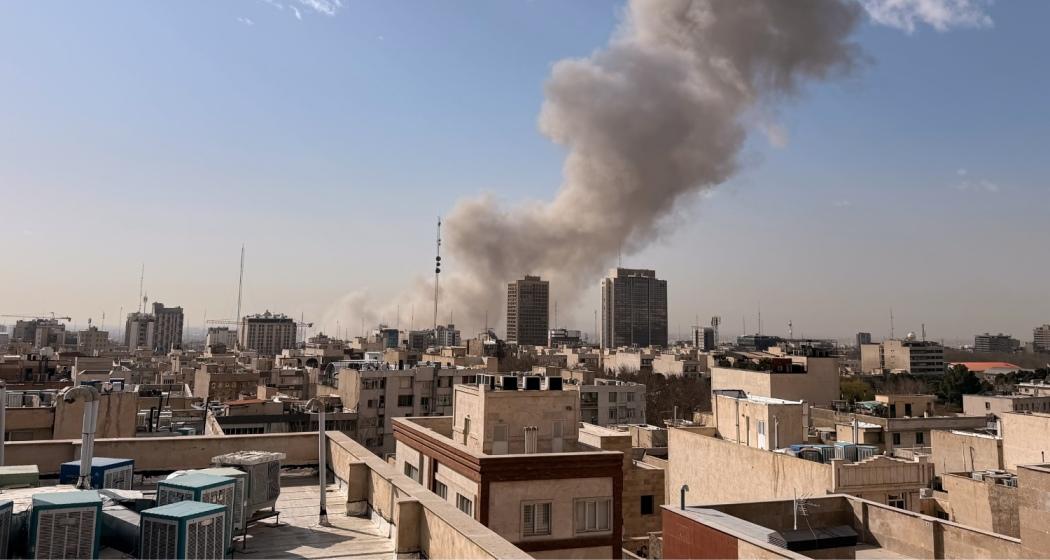
The United States and Israel launched a coordinated military strike on Iran early Saturday, targeting key leadership and military sites, including the offices of Supreme Leader Ayatollah Ali Khamenei. Smoke was seen rising across Tehran as multiple explosions rocked the capital. Sources indicate Iran’s Defence Minister Amir Nasirzadeh and Revolutionary Guards commander Mohammed Pakpour were killed in the attacks.
Iran responded by targeting US bases in Kuwait, Qatar, Bahrain, and the UAE. Explosions and sirens were reported across the Gulf. Iranian paramilitary forces, including the Revolutionary Guards, announced further attacks on Israel, while Iranian-backed Houthis in Yemen vowed renewed assaults on Red Sea shipping routes.
US President Donald Trump announced the strikes in a social media video, describing them as “major combat operations” and blaming Iran for continuing its nuclear programme and missile ambitions. He warned Iranian forces to surrender immediately, offering immunity or facing “certain death,” and urged civilians to take shelter.
Global leaders call for negotiations
European powers, while condemning Iranian attacks on neighbouring states, refrained from criticising the US‑Israel strikes. British Prime Minister Keir Starmer, French President Emmanuel Macron, and German Chancellor Friedrich Merz called for resumption of negotiations and protection of civilians. UN Secretary-General António Guterres warned that military escalation threatens international peace, citing violations of the UN Charter.
Saudi Arabia and Kuwait reported repelling Iranian attacks on their territories, while Bahrain confirmed a missile strike on the US Navy’s Fifth Fleet. Tehran saw panic buying and long queues at gas stations as citizens prepared for further escalation. Smoke and explosions were also reported near US bases in Iraq’s Kurdish region.
India, Russia China seek de-escalation in Middle East
India on Saturday called for immediate de-escalation in the Middle East after a joint military strike by the United States and Israel on Iran sparked a wider confrontation across the region. New Delhi urged all sides to exercise restraint and stressed that the sovereignty and territorial integrity of all nations must be respected.
In its first official response to the rapidly unfolding developments, the Ministry of External Affairs (MEA) said it was “deeply concerned” about the situation in Iran and the Gulf region.
“We urge all sides to exercise restraint, avoid escalation, and prioritise the safety of civilians,” the MEA said in a statement.
“Dialogue and diplomacy should be pursued to de-escalate tensions and address underlying issues. Sovereignty and territorial integrity of all states must be respected,” it added.
Meanwhile, Moscow described the strikes as “unprovoked aggression” and called for a return to diplomacy. China expressed deep concern, urging respect for Iran’s sovereignty and a halt to hostilities. Both nations warned that escalation could destabilise the Middle East and threaten global energy supplies.
US‑Israel’s justification
The Israel Defence Forces called the offensive “Operation Roaring Lion,” aimed at neutralising threats posed by Iran and its regional proxies. Washington framed the strikes as a preventive measure to stop Iran from acquiring nuclear weapons, though critics questioned the legality of the operation, especially during ongoing nuclear negotiations.
With civilian casualties mounting and the possibility of wider regional conflict looming, the Middle East teeters on the brink of full-scale war. International leaders are urging diplomacy, but the next days will determine whether restraint prevails, or whether the crisis escalates into a global confrontation.

 Follow us