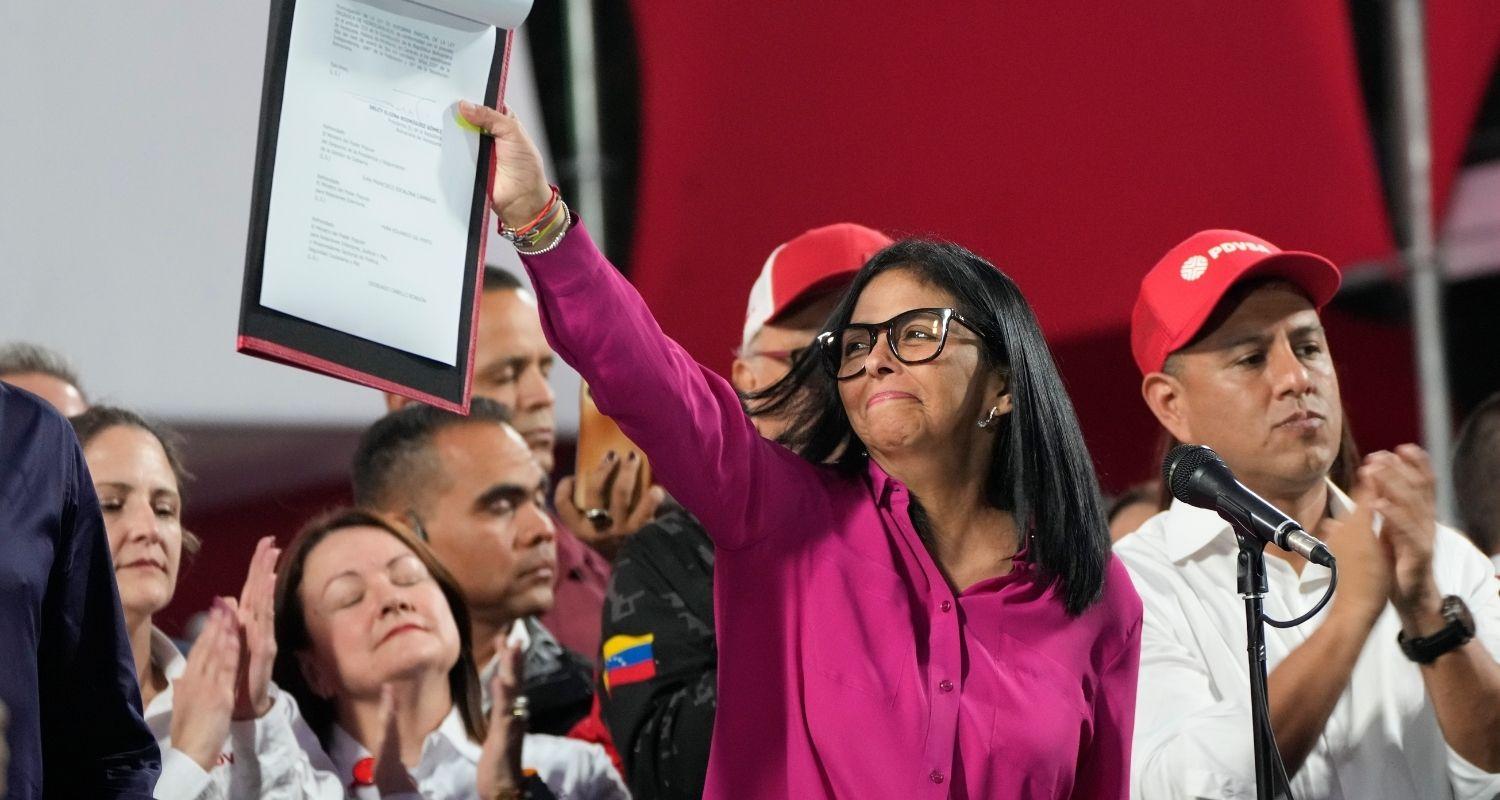
Venezuela’s interim President, Delcy Rodriguez, has announced an amnesty bill that could lead to the release of hundreds of opposition leaders, human rights activists, and journalists in the coming weeks.
On Friday, Rodriguez called for the establishment of a “new judicial system” and proposed an “amnesty law” that would eventually free detainees held in the country’s notorious intelligence detention centres.
Speaking at an event at the Supreme Court of Justice, Rodriguez said, “May this law serve to heal the wounds left by political confrontation, violence, and extremism. May it serve to restore justice in our country and peaceful coexistence among Venezuelans.”
The announcement follows a US military operation on January 3, during which American forces conducted raids in Caracas, abducted President Nicolás Maduro and his wife, and flew them out of the country to the United States to face charges of drug trafficking in a US court.
While the Venezuelan government has not yet published the text of the bill, Rodriguez indicated that it would cover cases dating back to 1999, while excluding individuals convicted of serious crimes such as murder, human rights abuses, and drug trafficking.
Also Read: Venezuela frees over 100 political prisoners: NGO
According to the Venezuelan human rights group, Foro Penal, there are approximately 711 political figures and opposition leaders detained in various prisons across the country.
The US-backed opposition has also called for the release of its leaders under the proposed amnesty.
Alfredo Romero, director of Foro Penal, wrote on social media: “A general amnesty is welcome as long as its elements and conditions include all of civil society, without discrimination; that it does not become a cloak of impunity; and that it contributes to dismantling the repressive apparatus of political persecution.”
Foro Penal also noted that the government has so far released 302 prisoners since January 8, a figure roughly half of the 771 claimed by Rodríguez.
Human rights organisation, Provea, said people had been arbitrarily imprisoned for exercising rights protected by international human rights instruments, the National Constitution, and Venezuelan laws.
“The announcement of an amnesty should not be conceived, under any circumstances, as a pardon or act of clemency on the part of the State,” Provea added.
Venezuelan Opposition leader and Nobel Peace Prize winner, María Corina Machado, described the amnesty proposal as a response to external pressure rather than it being a genuine initiative.
“This is not a voluntary gesture by the regime but a response to pressure from the United States government. And I hope that the prisoners will soon be able to be with their families,” she wrote on social media.

 Follow us