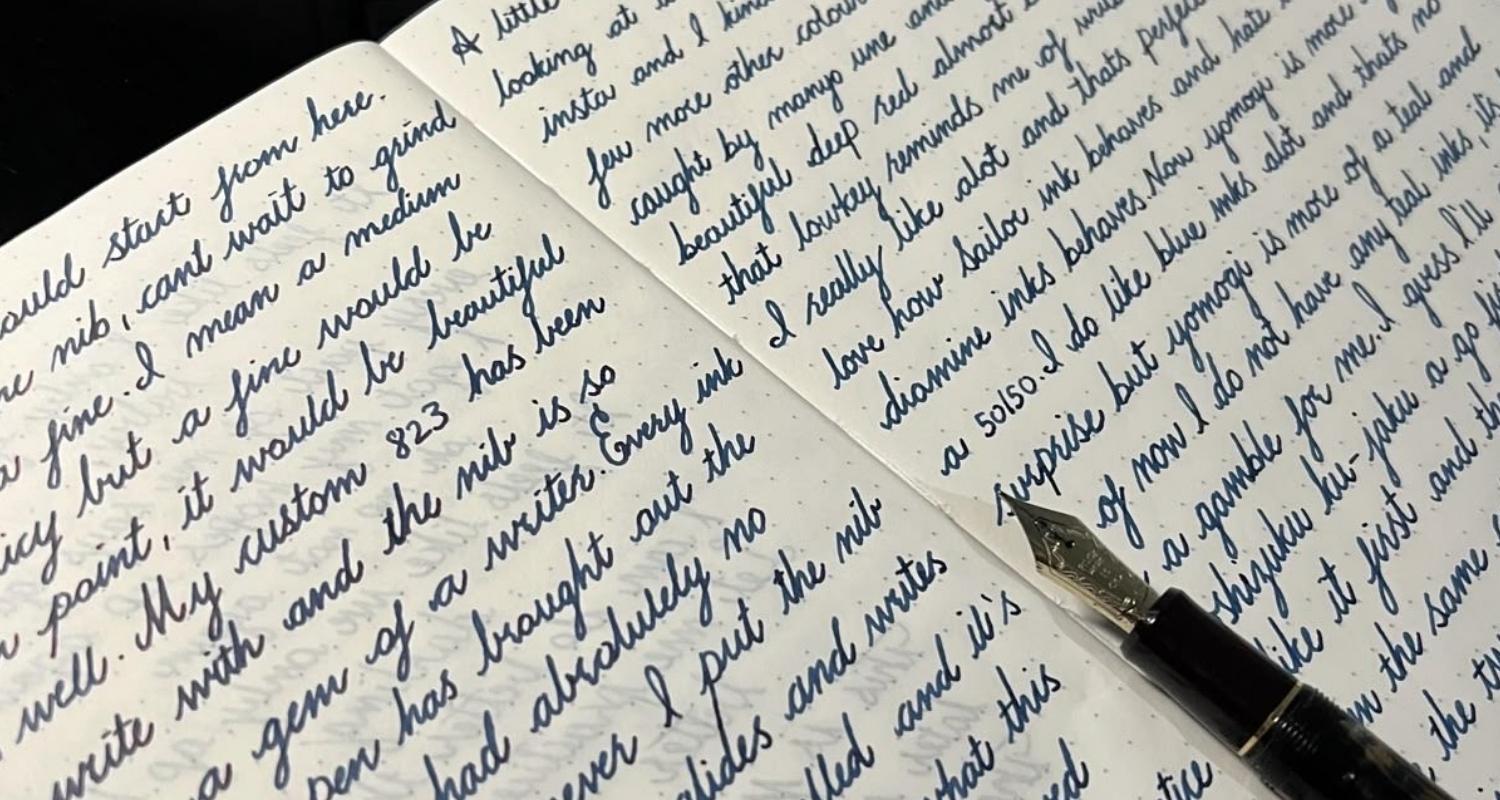
In the late 2000s, when technology began barging into the classrooms at a brutal pace, it led many to instantly believe in the superiority of keyboarding. Wasn’t that the future anyway? The edtech companies prevailed over the conventional curriculums and cursive was reduced to a practice of aesthetics, connected strokes, looped letters and a flowing hand. A font too, at best.
Almost a generation of students later, the return to cursive has been humbling, informed and now massive.
Earlier this year, Pennsylvania joined the host of states already formally welcoming cursive back into classrooms with a legal mandate. Governor Josh Shapiro announced on social media, how he signed the bill into law, using his “best cursive.”
“I’m definitely rusty, but I think my penmanship was okay,” he added. While Pennsylvania state representative Dane Watro, who sponsored the bill, said how cursive had been scientifically proven to boost cognitive growth while also preserving a link to the past as foundational documents like the Declaration of Independence and the US Constitution were written in cursive. He added, “More than half of US states already require cursive instruction in public schools. They recognise that cursive gives students another way to learn, express themselves and prepare for success academically, professionally and personally.”
How cursive was phased out, once upon a time
Cursive’s rightful acceptance back into classrooms has not been without a fair share of doubts and debate thrown its way, followed by exhaustive research in neuroscience backing the conventional practice. Between 2010 and 2020, schools in the US had removed cursive in as many as 45 states. Less than a decade ago, only 14 states in the US required schools to teach cursive. The Common Core State Standards adopted in 2010 removed the mandatory requirement for handwriting. While it removed the requirement for cursive, it added one for keyboarding.
India, where roughly half its population relies on a network of private schools for education, was no exception to the global trend. At the time, several private schools in the Capital, and Tier I cities updated their curriculums at par with global trends and signed off on the practice of writing. The move, over time, led to disastrous consequences with several studies and further research proving how that decision cost students badly and paving the way for keyboarding was a scientifically untenable idea.
Also read: Redefining exams in the age of ChatGPT
In 2024, Kentucky joined the cursive crusade with children expected to be proficient by grade 5. While Iowa’s education department also announced a similar move with children expected to be able to form all cursive letters, “efficiently and proportionately” by grade 3.
As of March 2026, more than half of US states strongly encourage cursive and 27 states have actually passed laws mandating the practice of handwriting.
So what happened in the past decade?
Cursive, also known as joined italics, not just makes letters appear calligraphic or aesthetic but has been proven to facilitate brain development and fine motor skills among children. It takes not just a steady hand, behind the skill but also a controlled movement and a coordinated mind. There is also no dearth of school blogs listing out the benefits of cursive handwriting and why it’s an essential part of their curriculums. According to the National Education Association (NEA), an organisation with over 3 million members comprising school teachers, faculty, and education support professionals, it is an important skill with several and proven cognitive benefits.
A 2024-study published in Frontiers in Psychology found that cursive handwriting activates synchronised brain activity in parts of the brain critical for memory formation, learning and reasoning. For the study, 16 healthy school-aged children and 16 healthy adults were recruited to participate in the study at Norwegian University of Science and Technology. In 2023, California passed a law mandating cursive writing in public schools.
“As a teacher for over 30 years, cursive writing was always an important part of our curriculum,” said Sharon Quirk-Silva, the lead sponsor of the state’s cursive law. “Research has shown that cursive handwriting enhances a child’s brain development, including memorization, and improves fine motor skills,” she said while signing cursive writing into law.
All this while, the proponents of cursive, mostly conventional educators who never stopped believing in the practice, kept it alive. Several cursive clubs were formed, although the members were seen as riding on nostalgia rather than science. Till science joined in to validate the long held academic belief. They say you never miss the water till the well runs dry and that has been true in the case of cursive.
By Manpriya Singh

 Follow us