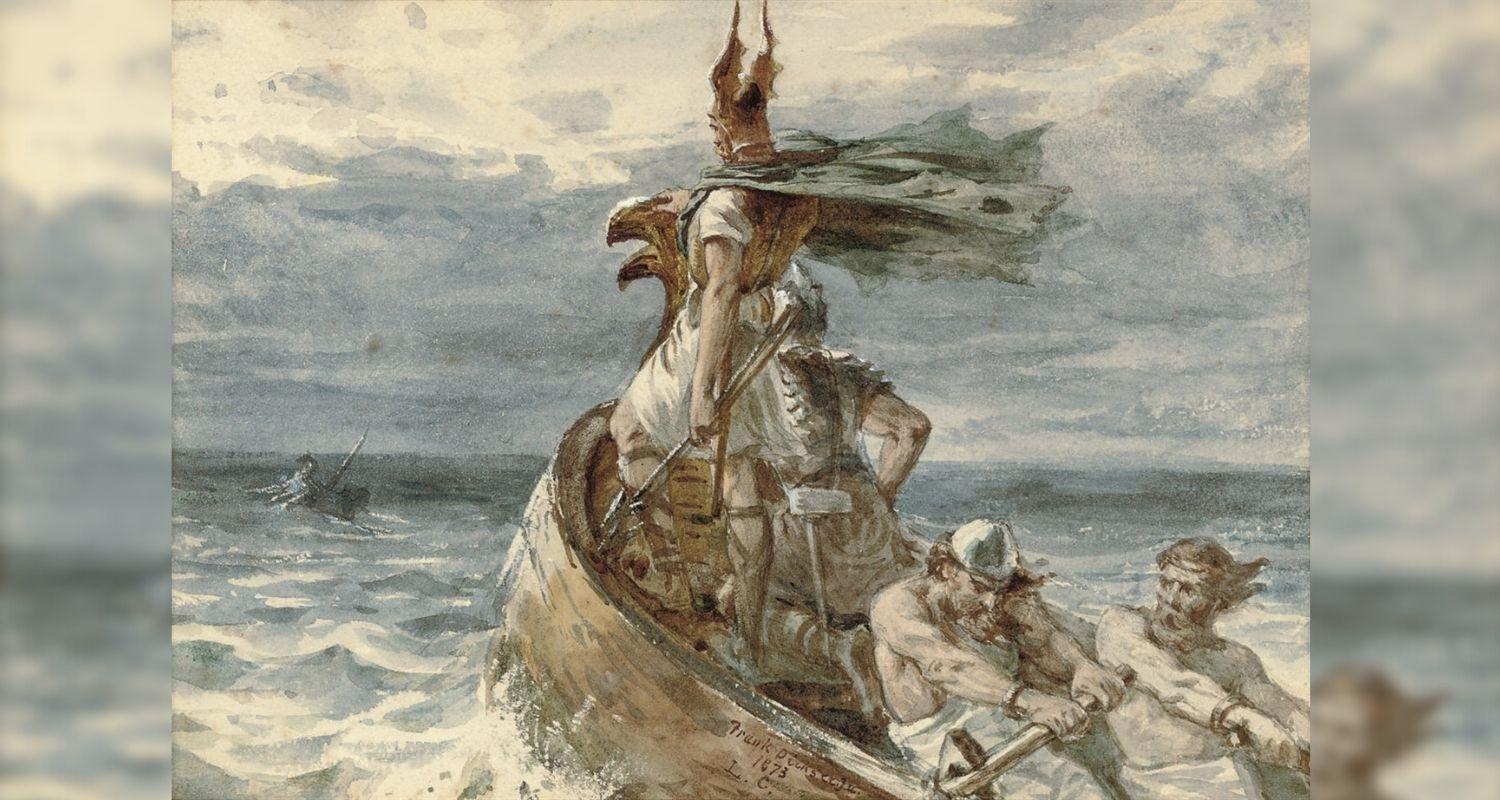
Around 2,400 years ago, before the emergence of the Roman empire, a small armada of boats approached the island of Als off the coast of southern Jutland in modern-day Denmark. The armada carried around 80 warriors armed with spears and shields. Some of them were officers, and these men carried iron swords.
The seafarers had travelled across what is now the Baltic Sea in sleek plank boats some 20 metres long. The planks were sewn together as boats at this time did not use metal nails, and the seams were caulked (waterproofed) with tar.
At some point along the voyage, they had stopped to repair their vessels. One of them left a partial fingerprint in the soft, newly applied caulking material between the plank seams. This sea-warrior—age and gender unknown—was inadvertently leaving a message for scientists who, more than two millennia later, would finally recognise the fingerprint’s significance using cutting-edge technology.
The small army was planning a quick marine assault on their enemies in Denmark—but their plans failed. Soon after they jumped on to the beach, these warriors were killed by the local defenders.
To give thanks for their victory against this invading force, the locals filled one of the boats with the weapons of the invaders and sank it into a local bog as an offering to the gods. Their decision to sink the boat in the bog has allowed future archaeologists to piece together clues about the events surrounding the attack, as well as the technology and society of these ancient people.
Today, this island bog in southern Denmark is known as the Hjortspring bog. In the late 19th century, the remains of the ancient boat were discovered, well preserved in its low-oxygen environment. At the time, the region had recently been conquered by Prussia and was part of the German empire, so the local Danes who found the boat kept their discovery secret until Als rejoined Denmark in 1920.
Also read: Ancient coral reefs reveal urgent truths about today's climate
The boat was finally excavated in 1921, and has been on display at the National Museum of Denmark in Copenhagen ever since. The excavation used the best archaeological methods that were available in the 1920s—but the scientific techniques of modern archaeology were not yet available.
In 2023, researchers from Lund University and the University of Gothenburg began a collaboration with the national museum in order to use modern scientific methods to study the materials pulled out of the Hjortspring bog over a century earlier. Some of these samples had never been studied since the original excavation—meaning that a major mystery had surrounded the Hjortspring boat ever since. Where did these invading warriors from the 4th century BC come from?
A surprising result
The weapons such as swords and spears found in the boat were used widely across northern Europe during the early iron age, giving few clues as to the boat’s provenance. Most archaeologists had assumed the boat came from somewhere nearby in Jutland, or perhaps from northern Germany.
By analysing the boat’s caulking material using a technique called gas chromatography-mass spectrometry, researchers were able to determine what chemical compounds the caulking tars were made from—a combination of animal fat and pine pitch.
This was surprising, since nearly all the pine forests in Denmark and northern Germany had already been cut down to make room for agriculture during the Neolithic period. Researchers know this because geologists have studied ancient pollen in lakes and bogs to determine what species grew in different parts of Europe and at what times.
While the people who built the Hjortspring boat may have traded items to acquire their tar, it was at that time possible to waterproof boats using materials local to Jutland such as linseed oil and tallow (cow fat). So, investigation suggests the Hjortspring boat probably did not come from Jutland or northern Germany—but rather, from a more distant location with access to abundant pine forests.
The closest large pine forests during the 4th century BC were located along the coasts of the Baltic Sea to the east of modern-day Denmark. This means the crew of the Hjortspring boat, and their fellow seafarers, may have travelled hundreds of kilometres across open sea to launch their attack on Als.
Researchers already knew that such long-distance voyages took place during the Bronze Age, when Scandinavians travelled far from home in search of copper. Iron was locally produced in Scandinavia, however, making the economic need for such voyages less obvious during the Iron Age.
Nonetheless, the results indicate that long-distance trading and raiding continued well after the end of the Bronze Age. While researchers will never know exactly what drove the warriors to launch this particular attack, research suggests that back then—just as today—political conflicts spanned regional borders and led young warriors to travel far from home.
Researchers were also able to carbon-date some of the lime bast rope used on the boat, giving the first absolute date from the original excavation material. The cordage dated to between 381 and 161BC, confirming the boat was from the pre-Roman Iron Age.
While selecting tar samples for their scientific analysis, researchers made another fantastic discovery: the “secret message” left by one of the crew in the form of a partial fingerprint left by one of the mariners on a small clump of tar.
Using X-ray tomography, researchers have made a digital 3D model of the fingerprint, accurate to the nanometre scale. From their analysis of the print, researchers believe it was left by an adult, although they cannot say much more at present about who this individual was. This exciting find gives the researchers a direct connection to this ancient warrior who once voyaged across the Baltic Sea.
Within the next year, researchers hope to be able to extract ancient DNA from the caulking tar on the boat, which could give them more detailed information about the ancient people who used this boat.
At present, results show that the practice of long-distance maritime trading and raiding, which came to characterise the famous Viking age, persisted over nearly 3,000 years of Nordic history. By studying this ancient boat, researchers can peer deeper into Scandinavia’s origins as a seafaring society.
Via The Conversation

 Follow us