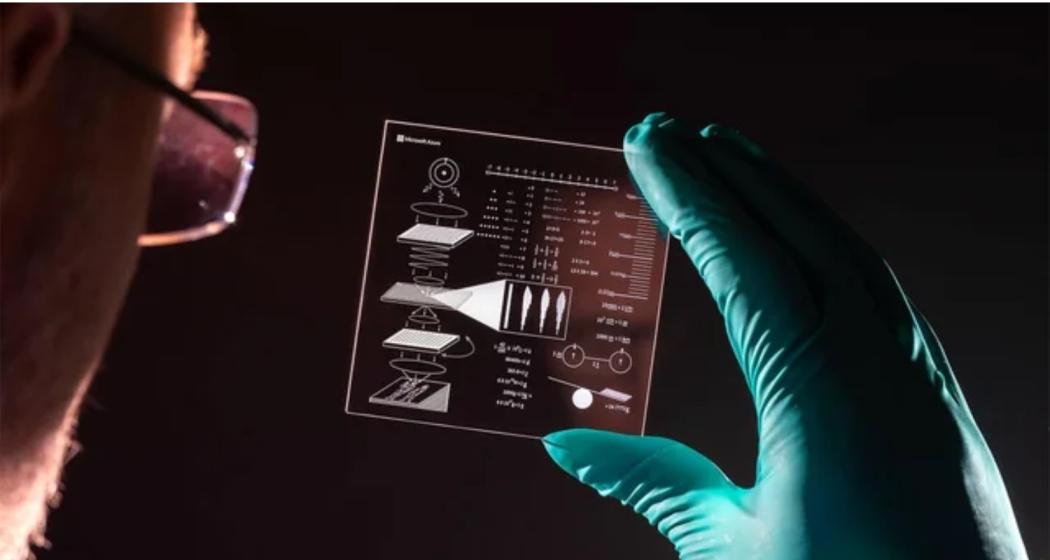
Writing data into glass using laser technology could enable information to be stored for more than 10,000 years, according to a study by researchers at Microsoft Research, Cambridge, published in Nature.
The Project Silica team has developed an archival storage system called “Silica” that uses a multibeam femtosecond laser to encode data into glass. The technique is resistant to moisture, temperature fluctuations and electromagnetic interference, offering a potential alternative to magnetic tapes and hard disk drives, which degrade within years or decades.
The researchers wrote that they “report an optical archival storage technology based on femtosecond laser direct writing in glass that addresses the practical demands of archival storage, which we call Silica.” They added that “optical storage approaches, particularly laser writing in robust media such as glass, have emerged as promising alternatives with the potential for increased longevity.”
Unlike earlier efforts that focused on improving individual parameters such as data density, the team developed an end-to-end system covering writing, storing and retrieving information.
Also read: L&T ties up with Nvidia for GW-scale AI factory ware
The system encodes data into three-dimensional pixels known as voxels, each capable of storing more than one bit of information. It achieves a writing capacity of 65.9 megabits per second, with a data density of 1.59 gigabits per cubic millimetre, equivalent to 4.84 terabytes in a 12-square-centimetre, two-millimetre-thick glass piece.
Feng Chen and Bo Wu of Shandong University, in a News and Views article accompanying the study, said this capacity equates to “about two million printed books or 5,000 ultra-high-definition 4K films.”
Lifetime experiments suggest the data could remain readable for up to 10,000 years if stored at 290°C, implying even longer durability at room temperature. However, the authors cautioned that these estimates did not account for mechanical stress or chemical corrosion that could degrade the glass medium.
Chen and Wu wrote that Silica “unites performance, durability and practical feasibility, transforming a laboratory concept into a viable solution for preserving the records of human civilisation.” They added that large-scale implementation could mark a milestone in knowledge storage comparable to oracle bones, medieval parchment or modern hard drives.

 Follow us