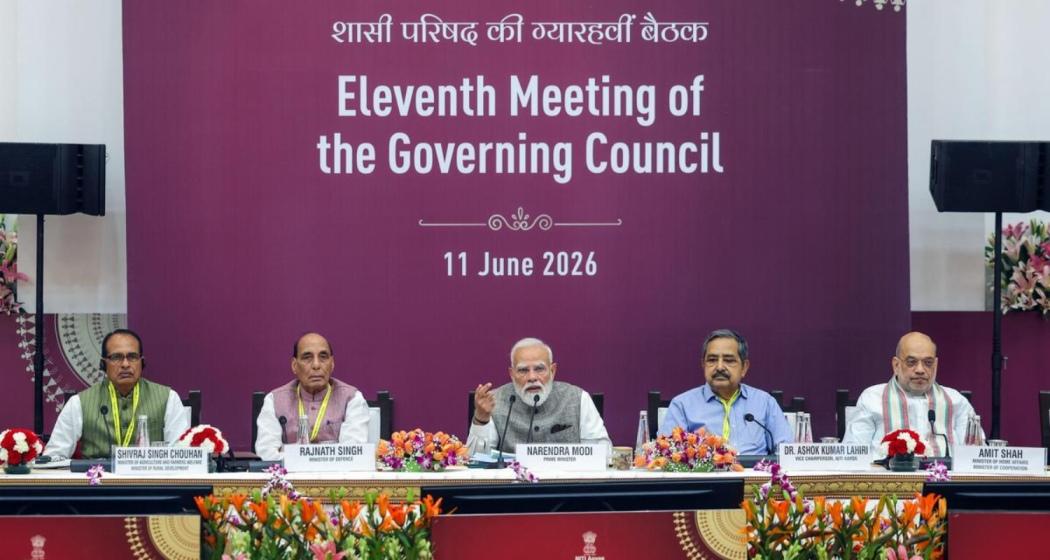
In a rare show of political unanimity, Chief ministers from all 28 states attended the 11th Governing Council meeting of NITI Aayog chaired by Prime Minister Narendra Modi in New Delhi on Thursday, marking a sharp departure from recent years of boycotts and partial participation.
The meeting, held at the Rashtrapati Bhavan Cultural Centre, also saw participation from Lieutenant Governors of Union Territories and Union ministers, making it one of the most comprehensively attended editions of the policy forum in recent memory.
Chief ministers from all seven opposition-ruled states, including Tamil Nadu, Karnataka, Kerala, Telangana, Jharkhand, Himachal Pradesh and Jammu and Kashmir, were present alongside BJP-ruled states such as Uttar Pradesh, Maharashtra and others.
In contrast to previous editions, where several opposition-ruled states either boycotted or sent representatives, this year’s meeting recorded full participation, signalling a notable shift in Centre–state engagement.
Cooperative federalism and growth agenda
Addressing the council, Prime Minister Modi said India continues to advance on its growth trajectory despite global uncertainty and instability, stressing that cooperative federalism remains central to achieving long-term development goals.
He urged states to strengthen efforts in education, skill development and employment generation, highlighting that India’s youth must be prepared for global opportunities through demand-driven skilling and quality education systems.
Also read: Soren seeks Centre’s support to fast-track Jharkhand's growth
Modi also emphasised the importance of women-led development, calling it a cornerstone of the vision for Viksit Bharat@2047. He said “Nari Shakti” is contributing across sectors—from agriculture and startups to science and innovation—and urged states to create enabling ecosystems for women’s empowerment, safety and participation.
MSMEs, trade pacts and state priorities discussed
The Prime Minister noted that India’s recent free trade agreements open significant opportunities for micro, small and medium enterprises (MSMEs), enabling them to integrate with global markets and improve competitiveness.
He also underlined the need for states to leverage emerging sectors such as manufacturing, innovation and services, while improving governance frameworks to attract investment and boost ease of doing business.
Following the meeting, several chief ministers held separate interactions with the Prime Minister, presenting development priorities and regional demands.
In his remarks shared on social media, Modi said the Centre and states were working together to accelerate India’s development journey, adding that collective efforts are essential to realise the vision of a developed India by 2047.

 Follow us