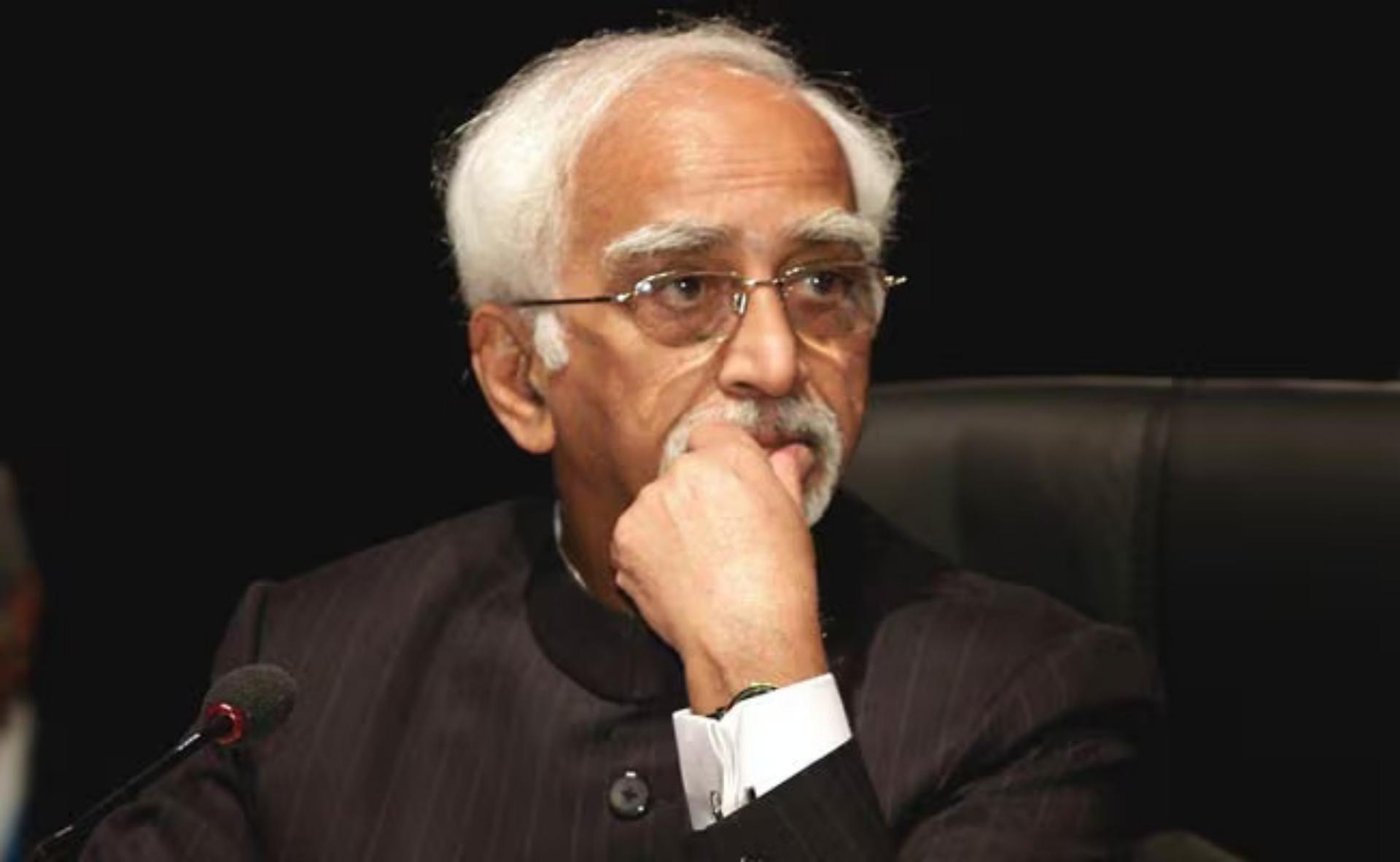
In what can provide fodder to political parties amid the ongoing correctional exercise of SIR by the Election Commission, former vice president Hamid Ansari has remarked not just on the democratic process but commented negatively on the fairness of elections in the country. where we have allowed money power in all its manifestations to “distort electoral outcomes” and failed to make them free and fair.
In his new book “Arguably Contentious: Thoughts on a Divided World”, Ansari also writes: “We have yet to succeed in eradicating electoral malpractices. We have allowed money power in all its manifestations to distort electoral outcomes and failed to make them free and fair.” He goes on to add: “Today we have to concede that the glass of democracy remains half full. We have practised electoral democracy mechanically without making it fully representative.” Ansari, who was vice president for two consecutive terms (2007-2017), claims our electoral procedures and practices have accentuated rather than diminished these deviations.
“Our political process depicts ideological decadence and a declining observance of constitutional morality. Our society exhibits a declining disregard for moral order and public conscience,” he writes.Similarly, developing tendencies of majoritarianism and weaponization of history to target specific segments of the citizen body have aggravated social cleavages, he says.Ansari also says that recent studies on religious minorities who constitute approximately 20 per cent of India’s population have traced discrimination relating to them to perceptions that relate to the very origins of thinking that brought about the Partition of August 1947.
“They argue that violence was not merely accidental but integral to the foundation of the nation and that the need for fraternity coexisted with the imperative need for restoring order,” he writes.“This has been written about on the basis of the documentation made available subsequently and, at this distance of time, its validity cannot be dismissed altogether for social cohesion in segments of society,” he adds.According to Ansari, political scientists and sociologists have written a good deal on the Indian perception of secularism.
“The three generally accepted characteristics of a secular state – liberty to practise religion, equality between religions as far as state practice is concerned, and neutrality or a fence of separation between the state and religion – have been invoked but ‘their application has been contradictory and has led to major anomalies’,” he argues.He also feels that Parliament has lost its effectiveness as an instrument of scrutiny, accountability and oversight, and instead, “devices of disruption crafted in Opposition and innocently disowned in government are sought to be legitimized”.
“Above all, the leadership of the day endorses it by studied silence or lack of attendance or both, and with a noticeable tardiness towards the functioning of the standing committees,” the former Rajya Sabha chairman writes.

 Follow us