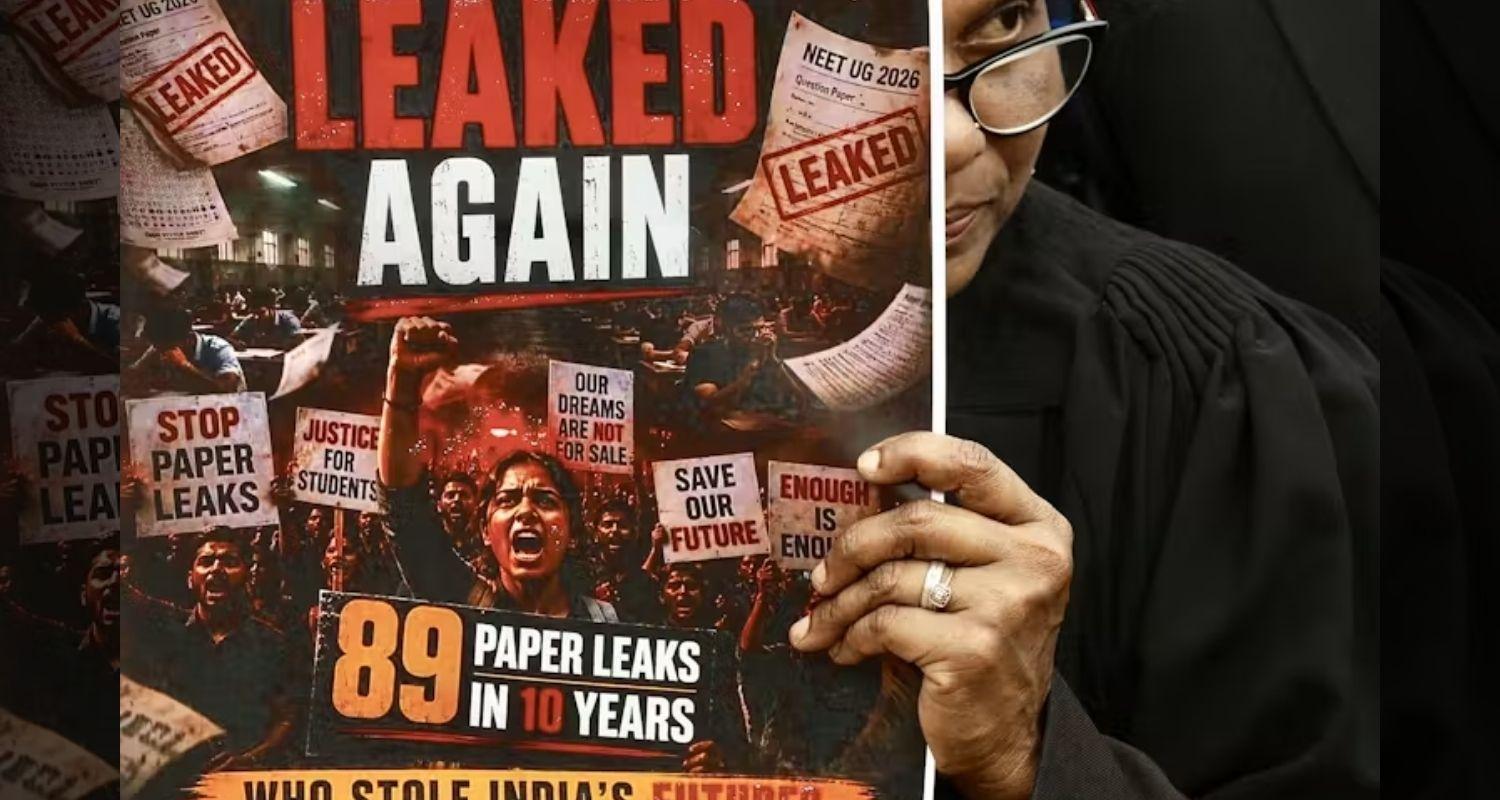
Over the past few weeks, young people have mobilised to protest India’s broken education system, against the background of a shortage of job opportunities.
The protests were initially sparked by the cancellation of a medical school entrance exam after questions were leaked, leading some despondent young people to take their own lives. The movement repurposed the image of a cockroach as their symbol – inspired by a comment by India’s chief justice, allegedly comparing jobless young people to “cockroaches”. Humour and satire were integral to the recent unrest.
On Saturday, the cockroach movement claimed its biggest victory since the protests began with the resignation of India’s Education Minister Dharmendra Pradhan. But this move will only do so much. These issues did not appear overnight, nor can they be easily fixed.
Decades of frustration
Irregularities and shortcomings in education, as well as rampant unemployment, have been major issues in northern India since at least the early 1970s. One of the main reasons for this is the economic growth that occurred in the late 20th century was not accompanied by broad-based investment in education. It also failed to create jobs in the private sector, leaving many young people dependent on government jobs.
As I wrote in my book Timepass: Youth, Class and the Politics of Waiting in India, for example, by the late 1990s, thousands of graduates were chasing a single government job in the northern city of Meerut.
In response, many young people engaged in what they called “timepass” – spending time hanging out at street corners while continuing to study for degrees. One set of students started a club called “Generation Nowhere”.
Many of the young people I interviewed were bitter about their predicament. Many could not afford the best schools. The education system was also rife with problems, from the frequent leaks of exam papers to teacher shortages.
When I was doing fieldwork relating to young people and social change in the state of Uttar Pradesh in 2004, I met students satirically campaigning for their “democratic right to cheat” in examinations. Like the young people at the heart of the cockroach movement, these students, too, complained of questions being leaked in advance of exams and the cheating inherent in the educational system.
They also believed talented students were cheated out of a job after graduating because of the scale of unemployment in India. “Why shouldn’t we cheat, when the system is cheating us?”, one student quipped.
Students also said the system of applying for government jobs was unfair. One told me: “Everywhere, you need source [social connections] and force [money power]”.
Today’s distinctive challenges
Young people today have similar feelings of anger and being stuck in limbo. But their daily realities have changed.
As Avishek Jha and Nilanjana Sen, two researchers at the University of Melbourne, recently argued, Indian youth are often channelling considerable effort into preparing for government exams, rather than engaging in “timepass”. This reflects a growing awareness of the real threat of youth unemployment in India and a determination to find ways to maximise their chances.
An enormous number of “tuition centres” or cram schools, coaching centres, and study spaces have emerged to cater to this more driven generation, but the odds stacked against young people in competition for scant government jobs remain the same. Cockroach protesters are frustrated by all the effort and resources they are forced to expend to prepare for exams that don’t ultimately lead to better lives.
This points to the deeper, systemic problems at the heart of India’s massive youth unemployment problem.
Four main issues to address
With their main demands now met by the government, those in the cockroach movement will likely shift their focus to these broader questions of fairness in education and employment.
First, tackling structural educational problems is an obvious priority. This may require decentralising the management of examinations. But as Professor Manisha Priyam pointed out in research in Bihar, the problem is wider than the leaking of examination papers. The government must also better regulate tuition and coaching centres to ensure their marketing and activities are transparent and above board.
Second, many Indian commentators are again emphasising the issue of job creation. The government should also look at ways to improve work-integrated learning to give students better training in key fields.
Another priority is reforming school and university courses so young people can obtain the skills necessary to compete for private and public jobs, while also creating opportunities for themselves through start-ups.
This is linked to a third issue – greater investment in schooling and higher education. Sixty years ago, a commission set up by the government to examine the state of education in India recommended the government increase spending to 6% of gross domestic product (GDP). This hasn’t happened: spending is currently just 4.1%.
Several experts have pointed out that education investment also needs to be smart. It should be targeted at curriculum review, improving the performances of institutions and staff, and speeding up the technological and infrastructural transformation in education.
A final theme emerging from the cockroach movement is the need for Indian authorities across the board to respect and value young people. This starts with a better understanding of the capabilities, talents and skills of those in gen Z.
Where to look for inspiration
Crucially, the cockroach movement is focusing attention on the realities of mainstream, public education – starting in primary schools – rather than simply what is happening in elite institutions.
There are some important initiatives underway that build on India’s National Education Policy. But to take a holistic approach to education reform and job creation, Indian policymakers should also look at developments in other large, developing countries, such as Brazil.
Policymakers must also look at India’s own history of successful community-government partnerships.
Above all, reforms that involve young people should now be the priority. Those in the cockroach movement have demonstrated their desire to become genuine collaborators in education reform. They deserve a seat at the table.
Via The Conversation

 Follow us