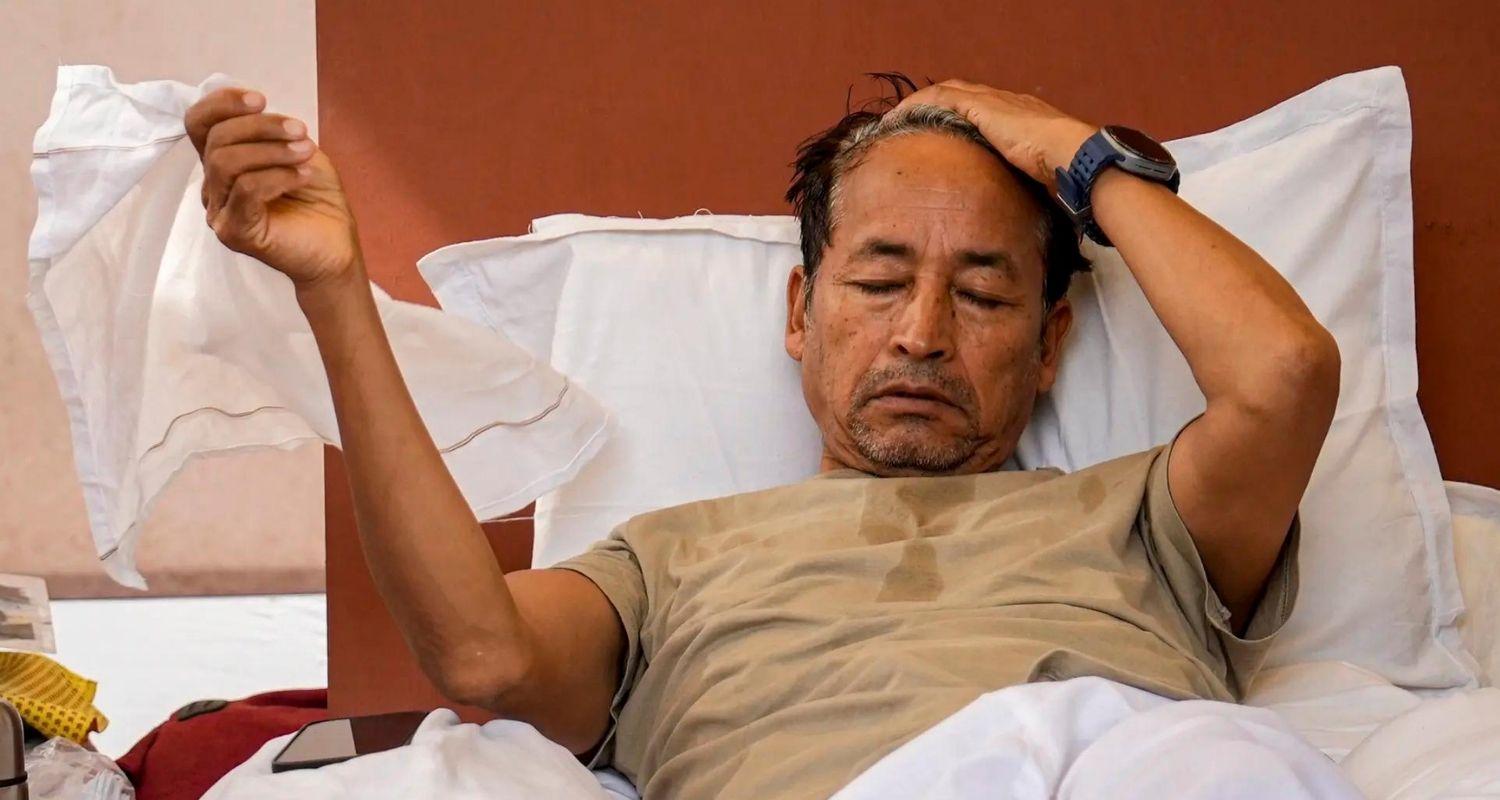
When Sonam Wangchuk was removed from Jantar Mantar after the Delhi High Court asked the government to monitor his health as it was deteriorating due to continuous fasting for 21 days, there was a lot of hue and cry from the supporters of the Cockroach Janata Party that it was undemocratic and that he had been “arrested”. The fact of the matter is that the government is trying to save his life which is at a great risk.
The issue is how justified is Wangchuk in resorting to such an extreme step. His demand is that Union Education Minister Dharmendra Pradhan must resign for the leak of the NEET paper. As a citizen of the country, he has a right to express his opinion. But that opinion cannot be binding on an elected government just because he resorted to hunger strike.
Wangchuk is not Mahatma Gandhi. Drawing parallels between the two is an absurd thing, as absurd as the name of the party, the Cockroach Janata Party, which is spearheading the campaign. Gandhi’s fasts were part of passive resistance against the foreign rulers. Indians did not have any voice anywhere. There were no elected representatives and elected governments. There was no freedom. There was no democracy. Gandhi made his voice heard by peaceful means using hunger strike as a powerful medium.
Wangchuk, or for that matter anyone else like Anna Hazare in the past, by resorting to hunger strikes are resorting to “political blackmail” and seeking to subvert an established system and process of a representative democracy. Good or bad, India has adopted a parliamentary form of representative democratic system of governance. Decisions are taken in a transparent manner. Maybe some people have reservations that the decisions are one-sided as the government uses its “brute majority” to push through its agenda, decision and legislation.
But that is the process and the system that the founding fathers of the Constitution adopted and accepted for the country. Rules, laws and regulations cannot be directed and dictated by mobs or individuals using blackmail tactics like “hunger strikes”.
Although the Congress today wants to be seen “shedding tears” in support of Wangchuk and criticising the government for removing him from Jantar Mantar, the party’s stand against the politics of hunger strikes has not been much different.
Like Wangchuk is on hunger strike now seeking Pradhan’s resignation, Hazare resorted to hunger strike in 2011 seeking the setting up of Lokpal to probe corruption at high places. Leader of Opposition Rahul Gandhi, who at that time was a member of the ruling party, had famously said, “The issue is not whether the government should have a Lokpal. The issue is whether we allow the process of law making to be dictated by one individual on a hunger strike.”
Senior Congress leader and then home minister P Chidambaram also echoed similar views, saying legislation should be shaped through parliamentary procedures, not by pressure created through hunger strike.
Both Rahul and Chidambaram were correct. Democracy cannot be allowed to be replaced by mobs. In fact, in the Cockroach Janata Party’s case, it does not even have mob support. The protesters are heavily relying on social media outreach and there is a huge gap between the virtual and the actual strength of the protests.
Also read: Congress treads cautious path on Wangchuk, CJP
It is the same Congress, which is now in opposition, that wants the government to talk to people like Wangchuk. Maybe the Bharatiya Janata Party’s position during the Anna protest in 2011 was not different as it was also in the opposition at that time.
It goes without saying that the Anna movement was propped up and supported by the BJP only to create a strong anti-corruption narrative against the Congress-led UPA government then. The Congress is now trying to “return the favour” to the BJP. But the party does not have as many resources, particularly in terms of the massive grassroots support base as the BJP enjoyed then and still continues to have.
Neither the BJP was right then nor the Congress is right now in propping up and supporting the extra-constitutional pressure groups and individuals to target the duly elected governments, oppose its decisions and impose its own agenda using political blackmail of hunger strike. In the end, it is the institution of the “government” that gets discredited.
Imagine the “anti-corruption” movement of Anna against a government that was headed by Prime Minister Dr Manmohan Singh, a man of immaculate character and incorruptible honesty. Yes, there may have been some people in the government involved in corruption. But assuming that the entire government was corrupt as the Anna movement sought to project, was absolutely wrong. Even those imaginary figures of presumptive loss to the government to the tune of Rs 1.75 lakh crores in 2G spectrum sale were taken as gospel truth! Later, a CBI court concluded that the loss was about Rs 38,000 crores only and that too, due to certain procedural lapses. All the accused in the case were acquitted. That is how narratives are built.
Coming back to Wangchuk’s fast. It is for getting the Union Education Minister sacked; the reason that the NEET papers were leaked. There are certain anomalies in the CBSE evaluation system also. Yes, there must be a lot of problems in running and managing the education ministry.
But should a minister really be held responsible for the paper leak of a competitive examination? Yes, repeated paper leaks are causing a lot of harassment to students. But that does not mean one should ask for the ‘head’ of the minister through a summary trial in a kangaroo court.
Yes, paper leaks are unacceptable. Given the enormity of the exam with 22 lakh students taking the test, it is a huge process involving tens of thousands of people. The system needs to be strengthened. But that does not mean it should be a reason to invite anarchy and hold the entire system to ransom.
Freedom to protest is fine, but it must be based on valid reasons. Such attempts at anarchy must be nipped in the bud and not allowed to mushroom for the sake of political correctness.

 Follow us