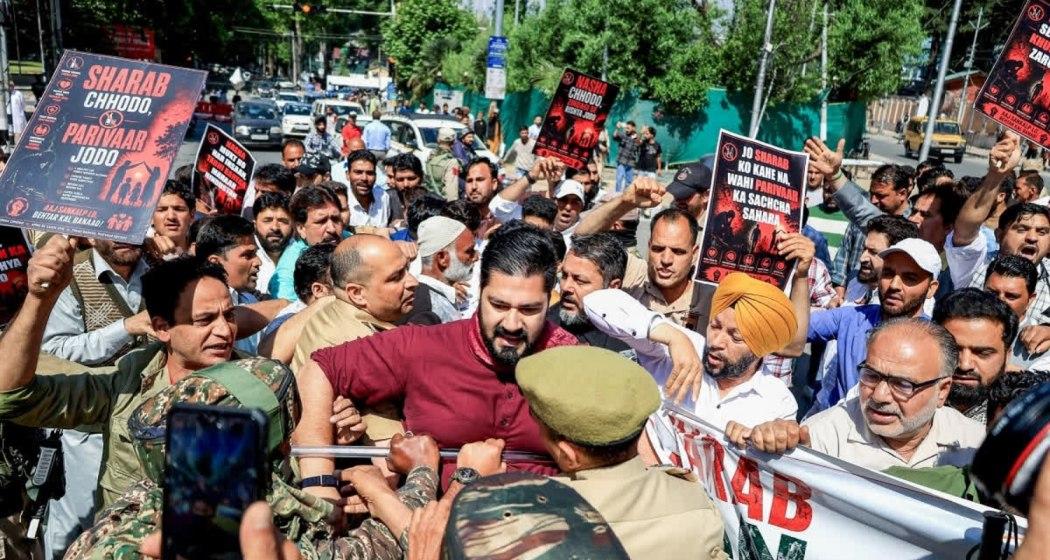
The Bharatiya Janata Party and the People’s Democratic Party, despite being ideologically opposed to each other, appear to be on the same page in demanding a ban on the sale of liquor in Kashmir.
Their fierce political hostility notwithstanding, the BJP and the PDP had earlier shared power in the erstwhile state of Jammu and Kashmir before it was downgraded into a Union Territory.
The ruling National Conference, however, disagrees. Chief Minister Omar Abdullah and National Conference president Farooq Abdullah have made it clear that nobody is forced to buy liquor and there is no question of banning its sale.
Not just the National Conference, even the PDP or the BJP, if they were in power, would find it difficult to impose such a ban. Liquor sales have risen substantially in Jammu and Kashmir, with liquor vends reportedly fetching around Rs 3,000 crore in the current fiscal.
This constitutes a significant amount when viewed against the nearly Rs 21,500 crore revenue generated by the Union Territory through various taxes. No government would willingly forgo such revenue, especially when prohibition could encourage smuggling.
The liquor trade has long been an easy political target, particularly for radical and extremist elements in Kashmir. During the early years of the insurgency in 1989-90, liquor shops were among the first and most frequent targets. A militant outfit called “Allah Tigers”, modelled in name after the LTTE — then regarded as one of the world’s most feared militant organisations, often attacked liquor vends with bombs.
There was also a joke doing the rounds at the time that while ordinary Kashmiris had little to do with attacks on liquor shops, many of those involved were themselves drinkers. They would allegedly loot the shops before bombing or setting them ablaze, as though trying to justify their actions in the name of religion.
Jokes apart, ordinary Kashmiris still appear largely detached from demands to ban liquor in the Valley. While religious beliefs strongly discourage alcohol consumption, many also recognise that no one can be compelled to drink against their will.
A large section of Kashmiris also understands that liquor sales are an important source of revenue for the Union Territory, particularly with tourism witnessing strong growth.
Comparisons are often drawn with Bihar, where prohibition is projected as successful. However, Kashmir and Bihar present very different situations. In Bihar, prohibition was introduced primarily to tackle serious social issues arising from widespread alcohol consumption.
Also read: BJP Kashmir targets Omar govt over liquor policy
In Kashmir, there is no comparable social problem, largely because local consumption remains relatively limited. While some Kashmiris do consume alcohol, they generally do so discreetly. It has not evolved into a major social concern of the kind witnessed in Bihar.
Even in many Islamic countries there is no blanket ban on liquor. Pakistan, for instance, permits non-Muslims and foreign visitors to consume alcohol. Luxury hotels across the country operate bars and serve liquor in hotel rooms. Licensed liquor shops also function in cities such as Karachi and Hyderabad in Sindh province. Several Arab countries similarly do not impose complete prohibition.
Unlike the Jammu region, where a majority of liquor consumers are locals, most consumers in the Kashmir Valley are tourists visiting from other parts of the country.
Over the past few years, Kashmir has witnessed a massive inflow of tourists. In 2024, around 2.35 crore tourists visited the Valley. The figure reportedly declined by nearly 60 lakh to 1.75 crore in 2025 following the Pahalgam terror attack in which 26 non-Muslim tourists were killed. However, tourist arrivals have already begun picking up this year and are expected to surpass previous records.
Flights to Srinagar continue to operate at near full capacity, while hotels remain crowded. With the direct rail link between Jammu and Srinagar now operational, travel to the Valley has become more convenient and hassle-free.
With tourist numbers expected to rise further, demand for liquor is also likely to increase. The Jammu and Kashmir administration understands this reality. Chief Minister Omar Abdullah, with his wider national and international exposure, also appreciates the role liquor availability plays in the tourism industry.
Ordinary Kashmiris, as already mentioned, largely remain indifferent to demands for prohibition, recognising that tourism is central to the region’s economic revival and growth.
Reopening liquor shops, much like reopening cinema halls, is often viewed as an indicator of returning normalcy in Kashmir. And Kashmir deserves to function normally, like any other part of the country.
So, let it be.

 Follow us