
Trending:
Bheem Army and AIMIM Join Hands: What It Means for UP Elections 2027
Asaduddin Owaisi and Chandrashekhar Azad join hands for UP Elections 2027. Know how the Bheem Army-AIMIM alliance could impact SP, Congress and BJP. Follow us
News Arena India - New Delhi - UPDATED: November 12, 2026, 06:34 PM - 2 min read
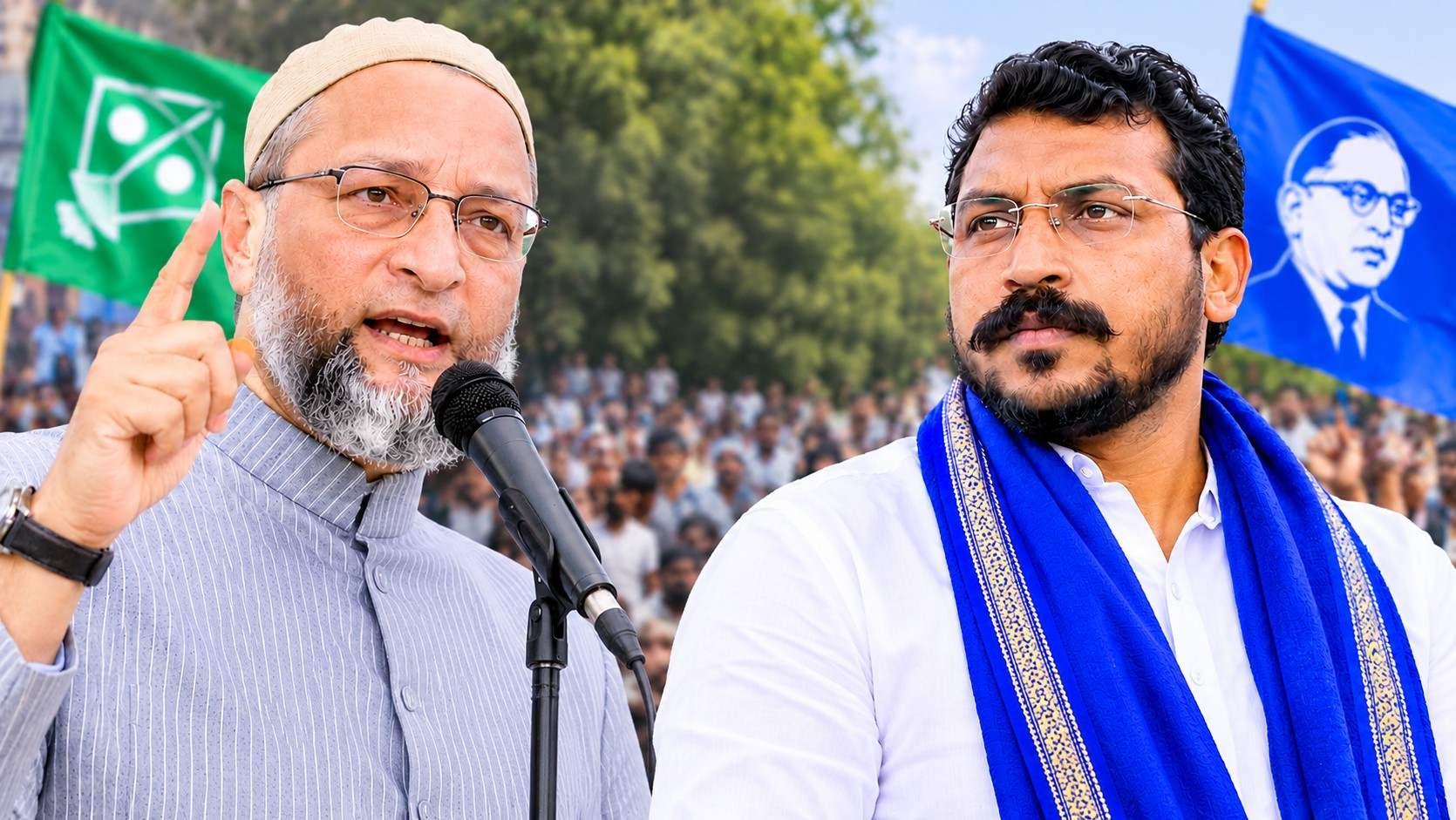
The alliance between Asaduddin Owaisi’s All India Majlis-e-Ittehadul Muslimeen (AIMIM) and Chandrashekhar Azad’s Azad Samaj Party (Kanshiram) has entered the Uttar Pradesh political contest ahead of the 2027 Assembly elections, presenting a new challenge to the existing Opposition arrangement in the state.
Named the Samajik Parivartan Morcha, the alliance says it will prevent the Bharatiya Janata Party (BJP) from forming a government in Uttar Pradesh for a third consecutive term. However, electoral calculations indicate that the Muslim-Dalit combination could affect the Samajwadi Party (SP) and Congress more directly than the BJP-led National Democratic Alliance (NDA).
Owaisi and Azad are seeking to bring together Muslim and Jatav Dalit voters. These communities were important to the SP-led INDIA bloc’s performance in the 2024 Lok Sabha elections and together account for around 40% of Uttar Pradesh’s electorate. A shift in their support could weaken the traditional vote base of the SP and the Congress, while also affecting the Bahujan Samaj Party (BSP).
Political analyst Amitabh Tiwari has estimated that the new front could secure between 3% and 7% of the vote, with 5% being a reasonable working estimate. Even such a vote share could influence results in closely fought constituencies, especially in western and eastern Uttar Pradesh.
Alliance names Chandrashekhar Azad as chief ministerial candidate
Owaisi and Azad announced the formation of the Samajik Parivartan Morcha in Lucknow on Thursday, November 12. Azad, the Nagina Lok Sabha MP and president of the Azad Samaj Party (Kanshiram), was named the alliance’s chief ministerial candidate for the 2027 Assembly elections.
Owaisi had earlier approached the SP for an alliance, but SP chief Akhilesh Yadav did not accept the proposal. With the SP unwilling to accommodate AIMIM, Owaisi joined hands with Azad, who is seeking to expand his party’s electoral presence in Uttar Pradesh.
Owaisi said the alliance would provide a strong alternative in Uttar Pradesh and prevent the BJP from returning to power for a third time. Azad rejected the description of the grouping as a third front, saying it should be viewed as the Samajik Parivartan Morcha rather than as a conventional third-front arrangement.
The two parties, however, have limited electoral records in the state. AIMIM contested 95 constituencies in the 2022 Assembly elections but won none, polling around 0.49% of the vote. Azad’s party also failed to win a seat and received around 0.13% of the votes.
Why the INDIA bloc faces a potential challenge
The 2024 Lok Sabha results provide the basis for concerns within the SP-Congress camp. The SP won 37 of Uttar Pradesh’s 80 Lok Sabha seats with a 33.59% vote share, while the Congress won six seats with 9.46%. The BJP secured 33 seats with 41.37% of the vote. The BSP received 9.39% but did not win a seat.
The INDIA bloc’s performance was supported by a consolidation of Muslim and Dalit votes. A CSDS-Lokniti 2024 post-poll survey found that 92% of Muslims, 56% of non-Jatav Dalits and 25% of Jatav Dalits backed the alliance.
Tiwari has estimated that almost two-thirds of the BSP’s support in the 2024 election came from Jatav Dalits, the community to which Azad belongs. Although his party obtained less than 1% of the statewide vote, Azad won the Nagina Lok Sabha constituency. His support among Jatavs and younger voters could help him draw at least 2% of the vote from the BSP, particularly in western Uttar Pradesh.
Owaisi, meanwhile, is seeking to consolidate Muslim support. Muslims account for nearly 20% of Uttar Pradesh’s population. His campaign has focused on the community’s political representation, with allegations that the SP and Congress have treated Muslims primarily as a vote bank without providing proportionate leadership opportunities.
Tiwari has said Owaisi’s emphasis on Muslim representation may appeal to younger Muslim voters dissatisfied with the opportunities offered by the SP and Congress. He has also pointed to Owaisi’s image as an articulate and assertive leader and the perception among some Muslim voters that AIMIM legislators would be less likely to support the BJP.
The potential impact is greater in constituencies where the SP or Congress fields a non-Muslim candidate and AIMIM offers a Muslim alternative. In such seats, a section of Muslim voters could prefer an AIMIM candidate viewed as less likely to join the NDA.
Congress leader Vijay Thottathil has described the alliance as a threat to the Opposition vote. He alleged that Owaisi had traditionally divided minority votes in a manner beneficial to the BJP and warned that the new arrangement could help the BJP by splitting votes opposed to it.
Possible impact across western UP and Purvanchal
Uttar Pradesh will elect representatives to a 403-member Assembly in 2027. Tiwari estimates that Azad could draw around 2% of the statewide vote from Jatavs, while Owaisi could secure a similar share among Muslims. Together, the alliance could reach around 5%, a level that could prove significant in close contests.
The distribution of these communities could make western Uttar Pradesh a key area for the alliance. The region has a sizeable Jatav population as well as several Muslim-dominated constituencies in Rohilkhand and the Upper and Lower Doab, the land between the Ganga and Yamuna rivers. Purvanchal, or eastern Uttar Pradesh, is another area where the front could make an impact.
More than 40 Assembly constituencies in the state have Scheduled Caste populations exceeding 20%, while over 90 constituencies have Muslim populations above 20%, according to Tiwari’s assessment.
The INDIA bloc also faces a stronger NDA social coalition in western Uttar Pradesh because of the BJP’s alliance with Jayant Chaudhary’s Rashtriya Lok Dal, which has support among sections of Jat voters.
In the 2019 Lok Sabha elections, the BJP won 15 of the state’s 17 Scheduled Caste-reserved seats. In 2024, the SP won seven such seats, the Congress won one and the BJP won eight. Azad won the remaining Nagina constituency.
Author and executive coach Randeep Sisodia has also assessed that the alliance could have a negative impact on Akhilesh Yadav. He said Owaisi’s public meetings were attracting large Muslim crowds and argued that the partnership with Azad could make the AIMIM chief appear to voters as a more formidable political option, potentially denting the SP’s Muslim support and helping the alliance win one or two seats.
Owaisi’s representation pitch and Azad’s Dalit appeal
The Samajik Parivartan Morcha is attempting to occupy political space outside both the NDA and the INDIA bloc. Owaisi has repeatedly accused the SP and Congress of seeking Muslim votes without offering the community adequate political representation. He has used the term “Abdul” to describe a Muslim voter who, in his formulation, had earlier been limited to supporting established parties and would now become an MLA.
AIMIM had sought an understanding with the INDIA bloc and gave the SP and Congress an October 2 deadline to respond. That arrangement did not materialise. The party later explored other possibilities, including an understanding with the BSP, before reaching an agreement with Azad.
The alliance’s emergence could complicate Akhilesh Yadav’s effort to maintain the SP’s PDA coalition. In 2024, the SP’s electoral formula brought together Yadavs, Muslims, sections of non-Yadav Other Backward Classes and Dalits. PDA initially stood for Pichhda, Dalit and Alpsankhyak, though Akhilesh has since used different expansions of the acronym to widen the party’s appeal.
The latest interpretation, “Pehle Darshan, Phir Aashirwad” or “first darshan, then blessings”, relates to Akhilesh’s proposed visit to the Ram Temple in Ayodhya. The BJP has used the visit and the SP’s past position on the Ram Janmabhoomi movement to target the SP chief.
Akhilesh’s Ayodhya visit adds another political complication
SP leader Pawan Pandey announced on November 7 that Akhilesh Yadav and his wife, Dimple Yadav, would visit the Ram Temple on December 12. If it takes place, it would be their first visit to the temple since its consecration in January 2024.
The announcement drew criticism from the BJP. Uttar Pradesh Chief Minister Yogi Adityanath demanded an apology over the 1990 police firing on kar sevaks during Mulayam Singh Yadav’s tenure. Uttar Pradesh BJP chief Pankaj Chaudhary challenged Akhilesh to visit Ayodhya on December 6, the anniversary of the Babri Masjid demolition.
The SP later clarified that the visit would not take place on November 12. Akhilesh subsequently confirmed plans to visit Ayodhya and Vrindavan on Wednesday, November 11. He linked the visits to the phrase “Pehle Darshan, Phir Ashirwad”, while the BJP accused him of using religion for electoral gains.
Tiwari has described the move as a possible exercise in soft Hindutva aimed at broadening the SP’s support among Hindu voters. At the same time, he said it could alienate some Muslim voters and give Owaisi greater room to argue for independent Muslim political representation.
The Samajik Parivartan Morcha says its objective is to prevent another BJP government in Uttar Pradesh. Its electoral strength will become clearer only after the alliance begins its campaign, but even a modest vote share could influence closely contested seats by dividing support among the SP, Congress, BSP and the AIMIM-Azad combine.
