
Trending:
Durga Puja Stampede: Major Challenge for CM Suvendu Adhikari
The Kolkata Durga Puja stampede presents a major test for Suvendu Adhikari, raising concerns over crowd management, public safety and his leadership as West Bengal Chief Minister. Follow us
News Arena India - New Delhi - UPDATED: October 18, 2026, 06:32 PM - 2 min read
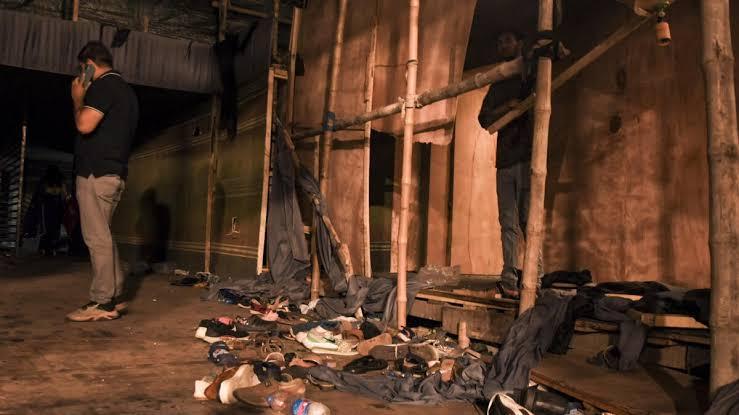
Kolkata Stampede Tests Suvendu Adhikari’s Leadership
Five months after taking charge as West Bengal Chief Minister, Suvendu Adhikari is facing his first major administrative and political crisis following the stampede at the Chorbagan Durga Puja pandal in North Kolkata. The tragedy has raised questions over crowd control, public safety arrangements and the administration’s preparedness for one of Bengal’s largest annual festivals.
At least 19 people died and 25 others were injured when the crowd surged at Chorbagan on the evening of October 17, the first of the two Saptami days in the 2026 Durga Puja calendar. The incident occurred in an area marked by narrow lanes, where thousands of visitors had gathered to enter the pandal.
The disaster has also brought scrutiny to the way Durga Puja committees were managed under the new government. Several committees earlier associated with Trinamool Congress leaders and ministers were sidelined or reorganised, while teams linked to the BJP emerged in prominent roles during this year’s celebrations.
BJP’s Durga Puja outreach
Union Home Minister Amit Shah was in Kolkata when the stampede occurred. His programme included a visit to Palermath and visits to, as well as inaugurations of, several Durga Puja pandals, including Shobhabazar Rajbari. The wider political objective was to engage with Bengali cultural identity and the social traditions surrounding Durga Puja.
A separate controversy had emerged a day earlier over a CPI(M)-organised book stall. A bulldozer operation took place at the site, and footage showed people attempting to handle or retrieve books. The exact circumstances of that incident remain to be clarified, but it had already become a political issue.
After the Chorbagan stampede, Adhikari spoke with Amit Shah, who cancelled his scheduled programmes and expressed grief over the deaths. Prime Minister Narendra Modi announced compensation, while the state government also declared compensation for those affected.
Adhikari visited the hospital and met the families of the victims. He blamed the tragedy on the organisers’ callousness, appealed to puja committees across Kolkata to adopt all necessary safety measures and described the incident as painful and deeply heartbreaking. He also said he had spoken to a sitting judge and would arrange an inquiry.
Questions over the police response
The police investigation is expected to establish how the crowd built up and whether the preventive arrangements were adequate. CCTV footage will be central to determining who was present, whether the Police Commissioner was at the location, which officials and organisers were responsible for specific arrangements, and how the situation developed at each stage.
The Chorbagan pandal stands in a part of Kolkata known for its narrow lanes. Such a venue requires clearly separated entry and exit routes, sufficient police deployment, trained volunteers, effective communication and emergency services positioned close to the gathering.
The local police station’s officer in charge reportedly reached the site with a team, followed by local police leadership and senior officers, including the Police Commissioner. However, the presence of senior officials did not prevent the stampede.
Visitors had gathered along the narrow Radha Madhab Shah Lane while waiting to enter the pandal. After 7 pm, rain began and the crowd suddenly moved forward. Rain had been forecast, raising questions about whether adequate contingency measures had been put in place. An announcement is also said to have added to the confusion.
The sequence has led to questions about the communication system, the control of entry and exit points and the organisers’ readiness to deal with a sudden change in weather. It has also highlighted the need for emergency announcements to be accurate and clear. The Chorbagan pandal was later closed.
Another possible accident was avoided at Chetla Agrani on Saturday evening when organisers noticed a crowd surge, stopped further entry and evacuated visitors already inside. Several other popular venues, including Tala Prattoy, College Square and Mohammed Ali Park, were also closed as a precaution. The decisions reflected concern that further crowd surges could result in more casualties.
Why Chorbagan attracted large crowds
Chorbagan Sarbojanin Durga Puja, located near a Ram Mandir, was celebrating its 91st year in 2026. The pandal had attracted visitors from the time it was inaugurated on October 12 and had become a major attraction because of its location and design.
This year’s theme was ‘Beyond Sound’. The installation featured an elevated, gallery-like structure built around the Durga idol, allowing visitors to view it from different angles. The 360-degree viewing experience was a major draw for the public.
Visitors came from Hooghly, Bardhaman, Medinipur and other parts of West Bengal. Publicity surrounding the pandal encouraged people from across the state to visit, adding to the pressure on the restricted space around the entrance and exit.
Questions have also been raised over the reported use of VIP passes. A narrow internal passage had been created inside the pandal, with a separate arrangement for VIP visitors. A substantial number of VIP passes were reportedly issued, although the exact figure was not known at the time.
Fire brigade personnel are said to have reached the site at a later stage, followed by senior Kolkata Police officials, including a joint commissioner from headquarters. The investigation will need to determine whether all required arrangements were available from the beginning or whether the response became coordinated only after the situation had worsened.
Political accountability under scrutiny
For Adhikari, the stampede is both a governance test and a major political challenge. His government will have to ensure a thorough inquiry and take action against anyone found responsible.
Several members of the Chore Bagan Sarbojanin Durgatsav Samity, the committee managing the puja, have been arrested. One account indicates that some people linked to the committee were absconding, while one person sought shelter at Girish Park police station. Trinamool Congress leader Kunal Ghosh, from the Mamata Banerjee faction, has questioned the role of the police and the impartiality of the authorities.
Adhikari has said there will be no compromise on accountability and that appropriate steps will be taken. He has also said he does not want the tragedy to become an occasion for political confrontation. The immediate priority, however, remains the treatment of the injured and support for the families of those who died.
A test of crisis management
The incident has exposed concerns beyond the functioning of a single puja committee. It has become a test of whether the administration can identify risks early and respond effectively when a large public gathering becomes unsafe.
Kolkata regularly hosts major cultural events and large public gatherings. As a precaution, police stations generally collect information about puja venues and visit pandals, while civic officials inspect the structures before and during the festival.
The central question now is how the government responds to the immediate crisis and what measures it adopts to prevent a similar tragedy in the future. The handling of the inquiry, the fixing of responsibility and the strengthening of crowd-management systems will remain under close scrutiny.