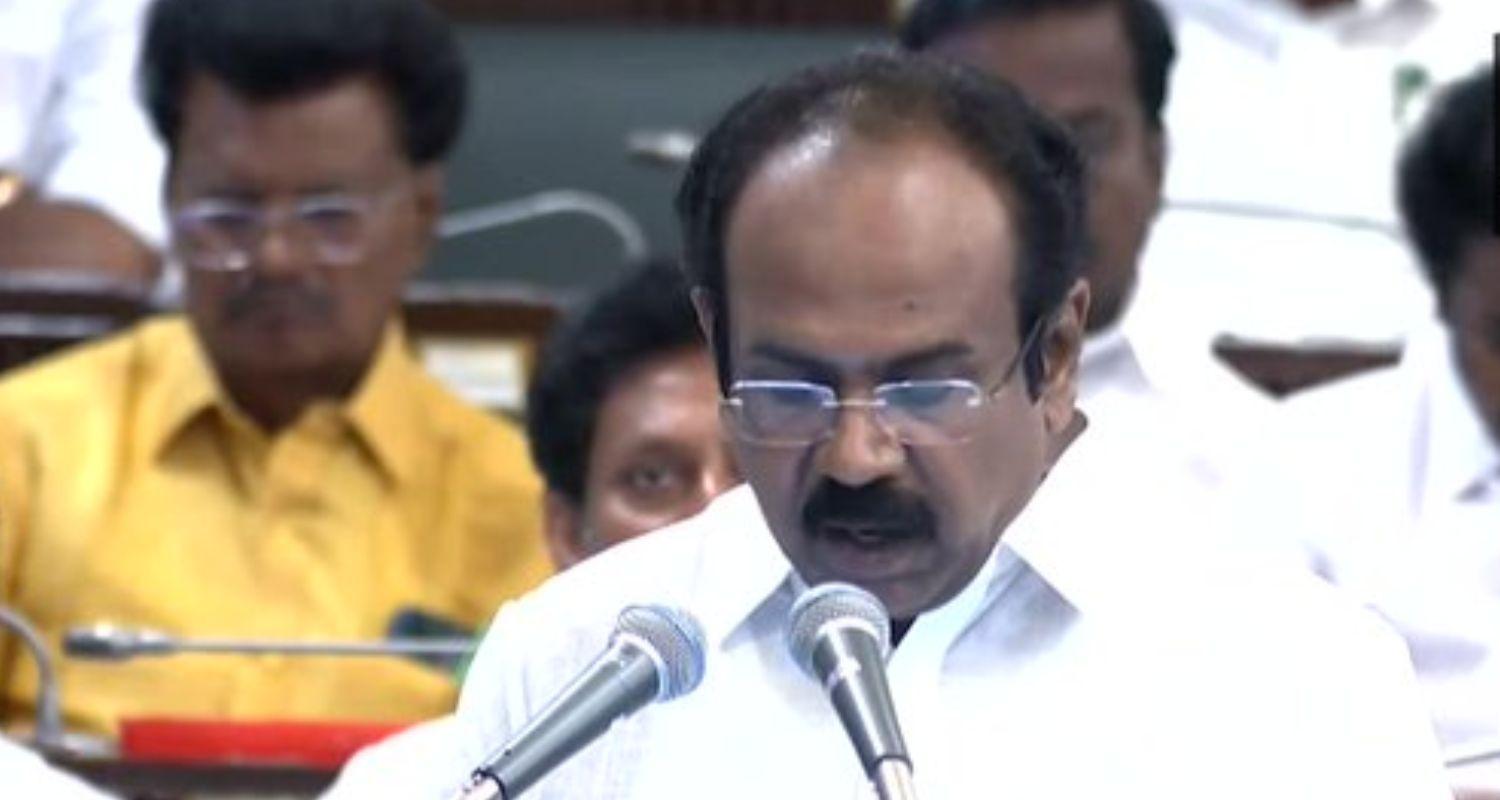
Tamil Nadu Finance Minister Thangam Thennarasu on Tuesday presented the State’s interim Budget for 2026–27 in the Assembly, with a strong emphasis on welfare schemes, education, industrial growth, sports development and cultural infrastructure ahead of the upcoming elections.
The minister announced several key allocations across sectors. Sports development received ₹718 crore, while the Rural Development Department was allotted ₹28,687 crore. The Special Programme Implementation Department was allocated ₹17,088 crore. Additionally, ₹10 crore has been earmarked to promote and teach Tamil among diaspora communities worldwide.
Social welfare remained a major focus, with ₹5,463 crore allocated for social security pension schemes for widows, destitute women and senior citizens. School Education received ₹48,534 crore, while Higher Education was allotted ₹8,505 crore.
For the welfare of persons with disabilities, the government announced ₹1,471 crore and decided to provide four per cent reservation in appointments along with promotional opportunities in public employment.
Thennarasu said the Chief Minister’s Breakfast Scheme has improved attendance and learning outcomes in government schools. He also highlighted the Kalaignar Magalir Urimai Thittam, under which ₹1,000 per month is given to women in recognition of unpaid household work. Recently, ₹5,000 was credited to 1.31 crore beneficiaries, he said.
To promote heritage and tourism, the government proposed a series of new museums, including a grand Chola Museum in Thanjavur, a museum at Gangaikondacholapuram, the Noyyal Museum in Erode district, the Naavaai Museum in Ramanathapuram district, and new Bronze and Indus Valley Civilisation galleries at the Egmore Government Museum in Chennai. A Tamil Cultural Museum is also planned in Tiruvannamalai. The projects will cost ₹285 crore.
In the industrial sector, the minister announced the Tamil Nadu Semiconductor Mission–2030, a five-year roadmap with an outlay of ₹500 crore. A Centre for Advanced Semiconductor Technologies will be set up at Taramani in collaboration with IIT Madras, along with a Centre of Excellence for semiconductor design and testing.
He also announced that a Tamil Nadu Shipbuilding Policy would be released soon. SIPCOT, along with the VOC Port Authority, is setting up a shipbuilding cluster in Thoothukudi at a cost of ₹5,200 crore through a Special Purpose Vehicle. Memorandums of understanding have been signed with major shipbuilding firms, including central public sector units and a global company, with proposed investments of around ₹30,000 crore.
The Industries, Investment Promotion and Commerce Department received ₹4,282 crore, while the MSME Department was allotted ₹1,943 crore. The minister said Tamil Nadu leads in the MSME sector, with over 40 lakh registered units and bank loans worth ₹10.70 lakh crore disbursed in the past five years.
Under the Kalaignar Kaivinai Thittam, artisans across 25 handicraft categories have received financial assistance and training. So far, 23,879 applications have been approved, facilitating ₹405 crore in credit and ₹83 crore in subsidies. A Gold Jewellery Park is also being developed in Coimbatore at a cost of ₹81 crore.
The state’s startup ecosystem has grown significantly, with over 13,000 registered startups in the last five years. The recent Global Startup Summit in Coimbatore saw participation from more than 150 international companies. Through TANSIM, schemes such as TANSEED and the Space Technology Fund have been launched, and a ‘Fund of Funds’ is in the pipeline.
In the IT sector, annual exports have crossed ₹2.5 lakh crore, providing employment to lakhs of professionals. Chennai alone hosts over 250 Global Capability Centres, while cities such as Coimbatore, Madurai and Tiruchirappalli are also emerging as IT hubs. According to the Software Technology Parks of India, IT exports were recorded from 32 of the state’s 38 districts in 2024–25.
Tamil Nadu has also released the country’s first Deep Tech Startup Policy. Through the iTNT Hub, support has been extended to 174 deep-tech startups, with MoUs signed with 27 incubators.
Under the high-speed broadband project, optical fibre connectivity is being extended to all 12,525 village panchayats through TANFINET. So far, 95 percent of the work has been completed, covering 11,953 panchayats. The Information Technology and Digital Services Department has been allocated ₹219 crore.
Describing the Budget as development-oriented, Thennarasu said the government aims to boost exports, control inflation, strengthen workers’ welfare, empower women’s self-help groups and achieve record food production in the coming year.
Also read: Tamil Nadu signs ₹5,980 crore semiconductor, aerospace MoUs

 Follow us